
Dehumidifiers

Citycool dehumidifiers create a healthy indoor climate.

The optimal relative humidity (RH%) in our living spaces is around 50%. Once the RH% rises above this, mold build up can, adversely effect, both our health, the building itself and possibly the goods we keep in the building.

Citycool dehumidifiers create a healthier indoor climate where moisture and mould do not get a chance to gain a foot hold.

Mold spores spread in the air and can adversely affect the respiratory tract and can be a common cause of allergies.

This can happen very often in our bedrooms, where, for example the RH% level can exceed the 60% mark. Excessive humidity levels in wet walls and windows, encourage reproduction of dust mites and mould spores.

Citycools supply and install both:

  1. Wall mounted dehumidifiers
  2. Portable dehumidifiers

Both these categories can be either:

Compressor/refrigerant dehumidifiers

Desiccant dehumidifiers (for use in areas with lower temperatures)

A Refrigerant based (compressor) dehumidifier removes the moisture from the surrounding air, thereby lowering the humidity. It does this by condensing water on a cold surface. This is like water collecting on the outside of the glass of a cold drink on a hot day. The fan within the dehumidifier pulls the humid air from the surrounding room into the dehumidifier. This air passes across a chilled cooling coil. The vapour within the air then condenses and the water created then drips into a drain or container. The resulting cold air is passed over a warm coil to bring it back to room temperature.

A Desiccant dehumidifier work using an adsorption agent like silica gel. The gel is applied in honeycomb form to an anorganic fleece – the drying wheel. The porous structure of the drying wheel provides an extraordinarily large surface area covering approx. 2,000 metres cubed. Rotation of the drying wheel allows adsorption and regeneration to occur in a continuous cycle.
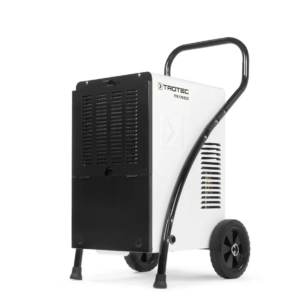
  • Home: Drying laundry, bedrooms, living rooms
  • Drying any space after leak
  • Keeping any area damp free
  • Holiday homes
  • Libraries and museums
  • Car storage
  • Preventing condensation build up on windows
  • Drying rooms in adventures centres
  • Drying rooms in Garda stations or emergency services stations
  • Swimming pools
  • Storage rooms
  • Factories, manufacturing / process areas and industrial plants
  • Warehouses
  • Retail outlets

Dehumidifiers are rated according to the following:

  • How many litres of water they can remove from the surrounding air in 24hours
  • The area or space (in m²) they can keep dry.

Be warned, some guidelines give fantastic sounding dehumidifying values which are set under test conditions with high humidity and high temperature. These guidelines are generally impossible to achieve in practise.

Knowing the cubic volume of the area you want to dehumidify will give you a good idea of which dehumidifier to use. If the size of the area you want to dehumidify is near the top end of a dehumidifiers stated capacity select the next size up.

Size selection of small dehumidifier by a rule of thumb:

  • At average room temperatures a 12Litre/24hour dehumidifier will keep a 14m² room at 55%RH
  • At average room temperatures a 16Litre/24hour dehumidifier will keep a 20m² room at 55%RH

55%RH (Relative humidity) is a general minimum requirement for most applications.

Keep energy consumption to a minimum by following these easy steps:

  • Select a correctly sized dehumidifier
  • Select the most energy efficient dehumidifier
  • Maintain the dehumidifier on a regular basis.
  • Operate dehumidifier according to manufacturers instructions

1) When purchasing your dehumidifier, it is definitely a good thing to make comparisons. There can be vast differences in quality in a lot of dehumidifiers – products that appear similar at first glance, may not be when their capacities are compared and examined carefully.

2) Some suppliers recommend dehumidifiers based on room size data, which in many cases are only achievable in laboratory conditions and almost never in practical use. The expected ambient temperature of the room is always decisive when choosing the appliance. In particular in the case of unheated rooms in which long term average temperatures of <15ºC prevail, effective dehumidification requires a dehumidifier with a defrosting system and a higher compressor performance. For applications with lower temperatures, a desiccant dehumidifier can be a better purchase.

At Citycool we will help you choose the best dehumidifier for your particular application with our many years of experience in this area.

3) Dehumidifiers are designed and usually sized to be effective only in the room they are located. Taking the overall area of a number of rooms is not the way to select your dehumidifier. If you want to dry a number of different rooms and you only have a single dehumidifier, place an air circulator or large fan in each of the rooms and move the dehumidifier daily.

For even faster drying, air circulators (fans) should be used in conjunction with your dehumidifier. Stronger air circulation leads to faster evaporation. Air, which is propelled by an air circulator, moves, at speed, over and across damp surfaces (floors/walls etc) and acts like a sponge, drying the surfaces, before it is sucked into the dehumidifier.

The drying time can be halved using both a dehumidifier and an air circulator.

Building Drying radically reduces heating costs:

Shorter and shorter building times and the increasing use of heat insulation mean that the moisture introduced during the building process is not permitted to be properly dried out. Damage as a result of excessive residual damp is inevitable. Heating costs for the home owner with residual damp are 200-300% higher in the first three years than for a dry building. This is due to the moisture related high heat conductivity.

Heating costs are two-three times higher in the three years after the building is completed if the building fabric is damp.

Citycool dehumidifiers can be used to dry your wet laundry. They are more energy efficient way to dry your clothes indoors than a conventional tumble dryer.

Dehumidifiers offer the advantage that laundry is dried slowly and gently over a longer time period – just like drying outside. Colours will stay brighter and last longer than drying with tumble dryers, while also using significantly less electricity.

In addition, sensitive materials such as wool, silk or synthetic fibers can be dried without any problems. In contrast to pure air drying, the laundry becomes much softer and more comfortable to wear on the skin.

Drying laundry is also possible with dehumidifiers without a laundry drying function. The target humidity value must then be set according to the desired residual moisture on your dehumidifiers hygrostat:

Closet dry: 46% relative humidity

Iron damp: 58% relative humidity

Dried: 65% relative humidity

Dehumidifiers

What Our Customers Say

City Cool exceeded my expectations! I needed a reliable air conditioning unit for my office, and their team guided me to the perfect solution. The installation was quick, and the system works flawlessly. Highly recommended!

Michael R.

Fantastic service from start to finish! We upgraded our home heating system with City Cool, and the difference is incredible. Our house is warmer, and our energy bills have even gone down. Couldn't be happier!

Sarah L.

City Cool is my go-to for ventilation solutions. They helped us install a high-quality system in our restaurant, and the air quality has never been better. Professional, friendly, and knowledgeable—great company to work with!

James P.

Absolutely top-notch service! City Cool installed a new air conditioning system in our home, and it's been a game-changer. The team was professional, efficient, and ensured everything was perfect before leaving. I highly recommend them!

Emma D.

Get in touch today.